


At NetSuite, resilience isn’t just a feature. It’s foundational to how our platform is engineered, because we know our customers’ businesses run on data. Here’s a comprehensive view of how NetSuite approaches disaster recovery (DR) and broader business continuity. While details may vary by region, product tier, and contract, these principles reflect how NetSuite is designed and operated as a SaaS platform within Oracle.
-
Overall objectives
- High availability first, fast recovery second. Our platform is engineered to avoid outages through redundancy and fault tolerance and to recover quickly if a site or component does fail. NetSuite guarantees a 99.7% availability outside of scheduled services windows and has delivered 99.96% availability over recent years.
- Transparency. NetSuite maintains a publicly available status page that continuously displays system uptime, including quantitative availability metrics, as well as up-to-the-minute announcements during disruptions.
- Data integrity and confidentiality. DR is tightly coupled with security controls, including encryption, access management, and independent auditing, to ensure data accuracy and protection during and after an incident.
- Adherence to audited controls. Controls and DR activities are subject to third-party audits, including the SOC 1/2 and ISO 27001 families, to give customers peace of mind.
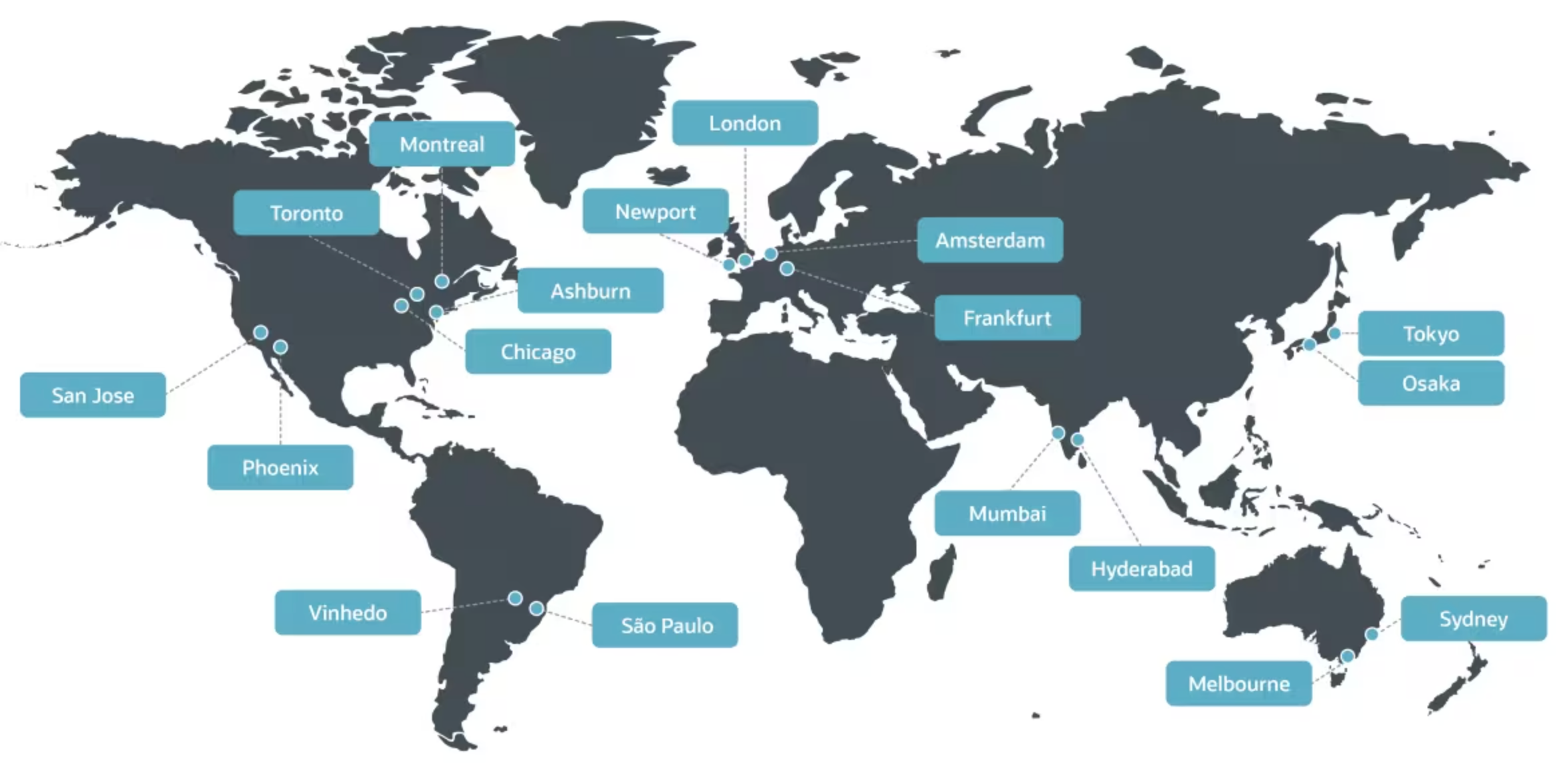
This world map highlights global locations including cities across North America, South America, Europe, Asia, and Australia. -
Architecture and redundancy
- Multitier, redundant design. Application servers, integration services, and databases operate in clustered, N+1 configurations. Load balancing and health checks route traffic away from failed nodes.
- Site/region pairing. Customer accounts are placed in a primary facility with a paired secondary facility, typically in the same general geography, to balance latency, compliance, and recovery. Traffic can be quickly redirected if a facility experiences an incident that affects availability.
- Segmented failure domains. Power, network, and storage are designed with redundancy and isolation to limit the radius of downtime. We enable component-level failover before site-level failover is considered.
-
Data protection and replication
- Continuous replication. Production databases are replicated to a secondary site to enable recovery if the primary becomes unavailable, with metrics based on your contract.
- Backup strategy. Regular, encrypted backups are stored separately from primary data storage. Multiple generations are retained to support point-in-time recovery scenarios.
- Encryption. Data is encrypted in transit and at rest. Keys are managed according to strict policies, and backups remain encrypted throughout their lifecycles.
- Integrity checks. Backups and replicas are validated for recoverability, with periodic restore tests as part of the standard control set.
-
Failover and recovery operations
- Automated detection and orchestration. Monitoring detects service health degradation and can trigger failover runbooks. Manual oversight is used for safety and verification.
- Tested playbooks. DR procedures for both partial- and full-site scenarios are documented, rehearsed, and continually refined.
-
Objectives and commitments
- Defined RPO/RTO. NetSuite targets the low recovery point and recovery time objectives customers expect for a global ERP provider, with a 12-hour RTO and one-hour RPO standard. A one-hour RTO and five-minute RPO service is available.
- Uptime and maintenance. NetSuite has a 99.7% uptime per month service-level commitment.
-
Security, compliance, and auditing
- Independent attestations. DR and continuity controls are covered in third-party assessments, such as SOC 1 Type II, SOC 2 Type II, and ISO 27001/27017/27018.
- Change and access controls. All changes follow formal change management processes, and least-privilege access and segregation of duties protect environments during recovery steps.
- Incident management. NetSuite provides defined severity levels, on-call response, containment/eradication processes, root-cause analysis, and customer communications for major incidents.
-
Data residency and sovereignty
- Regional hosting. Customers are placed in regions aligned with their data residency needs, such as EU hosting for EU data.
- Cross-border controls. Standard contractual and technical safeguards are used to comply with cross-border data transfer requirements.
-
Communication during incidents
- Status updates. NetSuite provides service status and incident communications via a dedicated status page.
- Support engagement. Critical incidents are worked 24×7 with severity-based response targets.
-
Continuous improvement
- Post-incident reviews. NetSuite performs root-cause analysis and takes corrective actions after major events.
- Capacity and resilience engineering. Dedicated Site Reliability Engineers champion improvements across infrastructure.
-
Customer best practices
- Configuration/version control. Use SuiteCloud Development Framework (SDF) and source control to version scripts and custom objects.
- Data export. Schedule regular exports via SuiteAnalytics Connect, REST/SOAP web services, or CSV to a secure repository.
- Integration resilience. Design integrations with idempotency and retry/backoff logic.
- Test critical processes. Validate business-critical reports and integrations after upgrades.
- Contact and notifications. Keep admin contacts current and subscribe to status notifications.
NetSuite’s disaster recovery and business continuity strategies are integral to how we serve our customers and protect their data. By combining robust security controls, a resilient architecture, and proven operational best practices, the NetSuite Data Management team works to keep customer data accurate, available, and protected even in the face of disruptions. As a SaaS solution within Oracle, we stay on top of emerging threats and industry requirements 24/7, freeing you to focus on your business with confidence.
Learn about the unique solutions NetSuite offers businesses to accelerate growth with a unified suite for financials, operations, and commerce.